Putting a device behind a service
In this tutorial you add a third stage, which lives in a program of its own. The session starts that program, and stops it when you close the window. It continues from Arranging the window.
So far your stages have kept their position in memory. Real hardware is
reached through a service, a separate
program that owns the hardware and offers its values over the network.
Apart from one new link, nothing you wrote before changes. The new stage
gets a row in the view of the stages, and an entry in the plan widgets of
walk and scan.
Devices without a service
A device can also reach its hardware on its own, but for now a service is the preferred way, and Services explains why. This tutorial uses one.
Before you start
What you need
caproto, to write the service, and ophyd-async[ca], so the device can
talk to it. Neither comes with redsun:
Open first_session.py, and add these imports below the ones it has:
from typing import Annotated

from ophyd_async.epics.core import EpicsDevice, PvSuffix

from redsun import AsService, Declare, Launch
1. Write the service
Make a second file in the project folder, beside the first, called
stage_ioc.py. Start it with these imports:
from caproto.server import PVGroup, ioc_arg_parser, pvproperty, run

from redsun.services import identity, stop_on_request
Then add the stage:
That's the whole stage: one value, named Position. caproto serves it over
Channel Access, one of the two
protocols of EPICS. A program of this
kind is called an IOC, and a value it serves
is called a process variable.
This stage only keeps a number. The service of a real stage would talk to its
controller in the same place, since caproto can call a function each time
Position is set.
A service that a session starts has to do two more things: stop when the session asks, and listen on this machine only. Add both below the stage:
if __name__ == "__main__":
me = identity()
prefix = me.prefix if me else "STAGE:"
options, run_options = ioc_arg_parser(default_prefix=prefix, desc="stage")
stop_on_request()
run(Stage(**options).pvdb, **{**run_options, "interfaces": ["127.0.0.1"]})
identity returns the name and
prefix the session gave the service. The
prefix is the start of the name of each process variable. When the service
runs alone, identity returns None, and the service falls back on
STAGE:. stop_on_request stops the
service as Ctrl+C would once the session asks, and does nothing when the
service runs alone.
Try the service on its own:
It prints Server startup complete. and waits. Stop it with Ctrl+C, and
don't leave it running, because the session starts its own. The service
listens on this machine only, so to read it with caget from another
terminal, set EPICS_CA_ADDR_LIST=127.0.0.1 there first.
On Windows, the service may print a few lines that end with
OSError: [WinError 995] as it stops. It has stopped all the same.
2. Write the device
In first_session.py, add a device below FastStage. Its position is the
process variable of the service:
class RemoteStage(EpicsDevice, StandardMovable[float]):
position: Annotated[SignalRW[float], PvSuffix("Position")]
@cached_property
def movable_logic(self) -> MovableLogic[float]:
return MovableLogic(setpoint=self.position, readback=self.position)
The device names only the end of the process variable, Position. The
beginning, the prefix, comes from the service you declare it with. Like the
other stages, it's a StandardMovable, and its one process variable is both
its setpoint and its readback.
3. Declare the service
Add the highlighted lines to the session. They declare the service and the stage, and add the link that sends the stage's position to the view:
class FirstSession(QtSession):
config = "session.yaml"
stage_ioc: Annotated[
AsService,
Launch("stage_ioc", ready="Server startup complete.", prefix="STAGE:"),
]
stage: AsDevice[MyStage]
fast_stage: AsDevice[FastStage]
remote_stage: Annotated[AsDevice[RemoteStage], Declare(service="stage_ioc")]
camera: AsDevice[SimBlobDetector]
stage_ctrl: AsPresenter[StagePresenter]
stage_plans: AsPresenter[StagePlans]
plan_ctrl: AsPresenter[PlanPresenter]
camera_ctrl: AsPresenter[CameraPresenter]
scan_plans: AsPresenter[ScanPlans]
stage_view: AsView[StageView]
plan_view: AsView[PlanView]
image_view: AsView[ImageView]
def wire(self) -> Iterator[Link]:
yield self.stage_view.sig_nudge, self.stage_ctrl.nudge
yield self.stage.position, self.stage_view.show_reading
yield self.fast_stage.position, self.stage_view.show_reading
yield self.remote_stage.position, self.stage_view.show_reading
yield self.plan_view.sig_run, self.plan_ctrl.run
yield self.plan_ctrl.sig_finished, self.plan_view.on_finished
yield self.plan_ctrl.sig_started, self.path_provider.set_plan
yield self.plan_ctrl.sig_finished, self.path_provider.reset_plan
yield self.plan_ctrl.sig_finished, self.camera_ctrl.show_last
yield self.camera_ctrl.sig_frame, self.image_view.show_frame
if __name__ == "__main__":
FirstSession().run()
AsService declares a service, under the name on the
left of its line. Launch says how to start it: the module
to run, which is the name of the file, then the line the service prints when
it's ready, and its prefix. Declare ties the stage to the
service, by the name the session gave the service.
You write the prefix only once, here, and the session hands it to both the service and the device.
4. Run it
The session starts the service, waits for it to be ready, and then builds the rest, as the terminal shows:
Service 'stage_ioc' started
Services started: 1/1
Session built: 4/4 devices, 5/5 presenters, 3/3 views
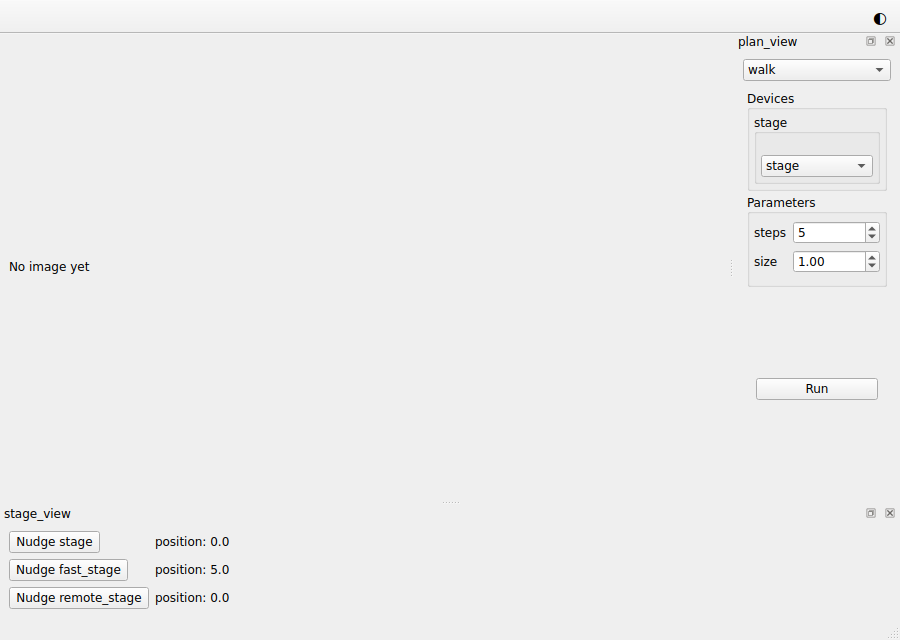
The window is the one from the last tutorial, with one more stage: the view
of the stages has a row for remote_stage, and the plan widgets of walk
and scan list it. Press its button, or choose it in a list of stages and
press Run. Its position counts up, kept by a different program from the
one drawing the window.
Two messages you can ignore
Channel Access may print one or both of these messages, which look like errors:
The first says that a helper program of EPICS is missing. The helper shares the announcements of servers between the programs of one machine, and without it a program takes longer to notice that a server has started again. The second says that the connection to the service closed while the session was still using it, because the service went away. Closing the window doesn't print it, since the session closes its connections before it stops the service.
One message you should not ignore
This message means another program the machine can reach also serves
STAGE:Position, and the stage may be talking to that one instead. It
could be another IOC on the network or, when your own
EPICS_CA_ADDR_LIST names 127.0.0.1, a stage_ioc.py left running in
another terminal. On a network shared with others, choose a prefix
nobody else uses.
5. Stop it
Close the window. The session stops the service it started:
The whole script
The service, stage_ioc.py:
"""The service launched in the "Putting a device behind a service" tutorial."""
from __future__ import annotations
from caproto.server import PVGroup, ioc_arg_parser, pvproperty, run
from redsun.services import identity, stop_on_request
class Stage(PVGroup):
    position = pvproperty(value=0.0, name="Position")
if __name__ == "__main__":
    me = identity()
    prefix = me.prefix if me else "STAGE:"
    options, run_options = ioc_arg_parser(default_prefix=prefix, desc="stage")
    stop_on_request()
    run(Stage(**options).pvdb, **{**run_options, "interfaces": ["127.0.0.1"]})
The session, first_session.py:
"""The session built in the "Putting a device behind a service" tutorial."""
from __future__ import annotations
from collections.abc import Iterator, Mapping # noqa: TC003
from functools import cached_property
from typing import Annotated, Any, Protocol, runtime_checkable
from urllib.parse import urlsplit
from urllib.request import url2pathname
import bluesky.plan_stubs as bps
import bluesky.plans as bp
import h5py
import numpy as np
from bluesky.protocols import Readable, Reading, Triggerable
from bluesky.utils import MsgGenerator # noqa: TC002
from event_model import DocumentRouter, StreamResource
from ophyd_async.core import (
MovableLogic,
SignalRW,
StandardMovable,
StandardReadable,
soft_signal_rw,
)
from ophyd_async.epics.core import EpicsDevice, PvSuffix
from ophyd_async.sim import SimBlobDetector # noqa: TC002
from psygnal import Signal
from qtpy.QtGui import QImage, QPixmap
from qtpy.QtWidgets import (
QComboBox,
QFormLayout,
QLabel,
QPushButton,
QStackedWidget,
QVBoxLayout,
QWidget,
)
from redsun import (
AsDevice,
AsPresenter,
AsService,
AsView,
CallbackType,
Declare,
DeviceMapping,
DevicesOf,
HasPlans,
Launch,
Link,
Placement,
PlanEntry,
slot,
)
from redsun.engine import RunEngine
from redsun.presenter.plan_spec import (
PlanSpec,
collect_arguments,
create_plan_spec,
resolve_arguments,
)
from redsun.qt import Central, Dock, QtSession
from redsun.view.qt.utils import PlanWidget, create_plan_widget
class MyStage(StandardReadable, StandardMovable[float]):
def __init__(self, name: str = "", *, units: str = "mm") -> None:
with self.add_children_as_readables():
self.position = soft_signal_rw(float, units=units)
super().__init__(name=name)
@cached_property
def movable_logic(self) -> MovableLogic[float]:
return MovableLogic(setpoint=self.position, readback=self.position)
class FastStage(StandardReadable, StandardMovable[float]):
def __init__(self, name: str = "", *, units: str = "mm") -> None:
with self.add_children_as_readables():
self.position = soft_signal_rw(float, initial_value=5.0, units=units)
self.speed = soft_signal_rw(float, initial_value=10.0)
super().__init__(name=name)
@cached_property
def movable_logic(self) -> MovableLogic[float]:
return MovableLogic(setpoint=self.position, readback=self.position)
class RemoteStage(EpicsDevice, StandardMovable[float]):
    position: Annotated[SignalRW[float], PvSuffix("Position")]

    @cached_property
    def movable_logic(self) -> MovableLogic[float]:
        return MovableLogic(setpoint=self.position, readback=self.position)
@runtime_checkable
class HasPosition(Protocol):
position: SignalRW[float]
@runtime_checkable
class Camera(Readable[Any], Triggerable, Protocol): ...
class StagePresenter:
def __init__(
self, name: str, *, stages: DevicesOf[HasPosition], step: float = 1.0
) -> None:
self.name = name
self.stages = stages
self.step = step
@slot
async def nudge(self, stage: str) -> None:
position = await self.stages[stage].position.get_value()
await self.stages[stage].position.set(position + self.step)
class StageView(QWidget):
placement: Placement = Dock("bottom")
sig_nudge = Signal(str)
def __init__(self, name: str, parent: QWidget) -> None:
super().__init__(parent)
self.name = name
self.rows = QFormLayout(self)
self.labels: dict[str, QLabel] = {}
def add_row(self, stage: str) -> None:
button = QPushButton(f"Nudge {stage}")
button.clicked.connect(lambda: self.sig_nudge.emit(stage))
self.labels[stage] = QLabel()
self.rows.addRow(button, self.labels[stage])
@slot
def show_reading(self, reading: dict[str, Reading[float]]) -> None:
for stage, entry in reading.items():
if stage not in self.labels:
self.add_row(stage)
self.labels[stage].setText(f"position: {entry['value']}")
class StagePlans:
def __init__(self, name: str) -> None:
self.name = name
def walk(
self, stage: HasPosition, steps: int = 5, size: float = 1.0
) -> MsgGenerator[None]:
for _ in range(steps):
position = yield from bps.rd(stage.position)
yield from bps.mv(stage.position, position + size)
def plan_map(self) -> Mapping[str, PlanEntry]:
return {"walk": {"plan": self.walk}}
class PlanPresenter:
sig_started = Signal(str)
sig_finished = Signal()
def __init__(self, name: str, *, devices: DeviceMapping) -> None:
self.name = name
self.devices = devices
self.engine = RunEngine()
self.plans: dict[str, PlanEntry] = {}
self.specs: dict[str, PlanSpec] = {}
def setup(
self,
plan_sources: Mapping[str, HasPlans],
callbacks: Mapping[str, CallbackType],
) -> None:
for component in plan_sources.values():
self.plans.update(component.plan_map())
for plan, entry in self.plans.items():
self.specs[plan] = create_plan_spec(entry["plan"], self.devices)
for callback in callbacks.values():
self.engine.subscribe(callback)
@slot
def run(self, plan: str, values: dict[str, Any]) -> None:
resolved = resolve_arguments(self.specs[plan], values, self.devices)
args, kwargs = collect_arguments(self.specs[plan], resolved)
self.sig_started.emit(plan)
future = self.engine(self.plans[plan]["plan"](*args, **kwargs))
future.add_done_callback(lambda _: self.sig_finished.emit())
class PlanView(QWidget):
placement: Placement = Dock("right")
sig_run = Signal(str, dict)
def __init__(self, name: str, parent: QWidget) -> None:
super().__init__(parent)
self.name = name
self.chooser = QComboBox()
self.pages = QStackedWidget()
self.chooser.currentIndexChanged.connect(self.pages.setCurrentIndex)
layout = QVBoxLayout(self)
layout.addWidget(self.chooser)
layout.addWidget(self.pages)
self.widgets: dict[str, PlanWidget] = {}
def setup(
self, plan_sources: Mapping[str, HasPlans], devices: DeviceMapping
) -> None:
for component in plan_sources.values():
for entry in component.plan_map().values():
self.add_plan(create_plan_spec(entry["plan"], devices))
def add_plan(self, spec: PlanSpec) -> None:
widget = create_plan_widget(
spec, run_callback=lambda: self.ask_to_run(spec.name)
)
self.widgets[spec.name] = widget
self.chooser.addItem(spec.name)
self.pages.addWidget(widget.group_box)
def ask_to_run(self, plan: str) -> None:
self.setEnabled(False)
self.sig_run.emit(plan, self.widgets[plan].parameters)
@slot
def on_finished(self) -> None:
self.setEnabled(True)
class CameraPresenter(DocumentRouter):
sig_frame = Signal(object)
def __init__(self, name: str, *, cameras: DevicesOf[Camera]) -> None:
super().__init__()
self.name = name
self.cameras = cameras
self.written: tuple[str, str] | None = None
def snap(self, camera: Camera, frames: int = 3) -> MsgGenerator[Any]:
return (yield from bp.count([camera], num=frames))
def plan_map(self) -> Mapping[str, PlanEntry]:
return {"snap": {"plan": self.snap}}
def stream_resource(self, doc: StreamResource) -> StreamResource:
if doc["data_key"] in self.cameras:
self.written = (doc["uri"], doc["parameters"]["dataset"])
return doc
@slot
def show_last(self) -> None:
if self.written is not None:
uri, dataset = self.written
with h5py.File(url2pathname(urlsplit(uri).path), "r") as file:
self.sig_frame.emit(file[dataset][-1])
self.written = None
class ImageView(QWidget):
placement: Placement = Central()
def __init__(self, name: str, parent: QWidget) -> None:
super().__init__(parent)
self.name = name
self.image = QLabel("No image yet")
QVBoxLayout(self).addWidget(self.image)
@slot
def show_frame(self, frame: object) -> None:
values = np.asarray(frame, dtype=float)
low, high = values.min(), values.max()
grey = (255 * (values - low) / max(high - low, 1.0)).astype(np.uint8)
height, width = grey.shape
image = QImage(
grey.tobytes(), width, height, width, QImage.Format.Format_Grayscale8
)
self.image.setPixmap(QPixmap.fromImage(image.copy()))
class ScanPlans:
def __init__(self, name: str) -> None:
self.name = name
def scan(
self,
stage: HasPosition,
camera: Camera,
start: float = 0.0,
stop: float = 5.0,
points: int = 6,
) -> MsgGenerator[Any]:
return (yield from bp.scan([camera], stage.position, start, stop, points))
def plan_map(self) -> Mapping[str, PlanEntry]:
return {"scan": {"plan": self.scan}}
class FirstSession(QtSession):
    config = "session.yaml"
    stage_ioc: Annotated[
        AsService,
        Launch("stage_ioc", ready="Server startup complete.", prefix="STAGE:"),
    ]
    stage: AsDevice[MyStage]
    fast_stage: AsDevice[FastStage]
    remote_stage: Annotated[AsDevice[RemoteStage], Declare(service="stage_ioc")]
    camera: AsDevice[SimBlobDetector]
    stage_ctrl: AsPresenter[StagePresenter]
    stage_plans: AsPresenter[StagePlans]
    plan_ctrl: AsPresenter[PlanPresenter]
    camera_ctrl: AsPresenter[CameraPresenter]
    scan_plans: AsPresenter[ScanPlans]
    stage_view: AsView[StageView]
    plan_view: AsView[PlanView]
    image_view: AsView[ImageView]

    def wire(self) -> Iterator[Link]:
        yield self.stage_view.sig_nudge, self.stage_ctrl.nudge
        yield self.stage.position, self.stage_view.show_reading
        yield self.fast_stage.position, self.stage_view.show_reading
        yield self.remote_stage.position, self.stage_view.show_reading
        yield self.plan_view.sig_run, self.plan_ctrl.run
        yield self.plan_ctrl.sig_finished, self.plan_view.on_finished
        yield self.plan_ctrl.sig_started, self.path_provider.set_plan
        yield self.plan_ctrl.sig_finished, self.path_provider.reset_plan
        yield self.plan_ctrl.sig_finished, self.camera_ctrl.show_last
        yield self.camera_ctrl.sig_frame, self.image_view.show_frame


if __name__ == "__main__":
    FirstSession().run()
What you built
You wrote a service that serves a stage, and a session that starts it, talks to it and stops it. The application now has three stages, a camera, five presenters and three views.
Next steps
- Reusing the built-in positioner is the next
tutorial, where you replace the nudge presenter and view with the
positioner
redsunships. - How to write a service serves a stage with
fastcsover another protocol, and covers services that already run elsewhere, and what to do when one exits. - How to run a session without hardware runs the same window with no service behind it.
- Services explains why devices and services are kept apart.